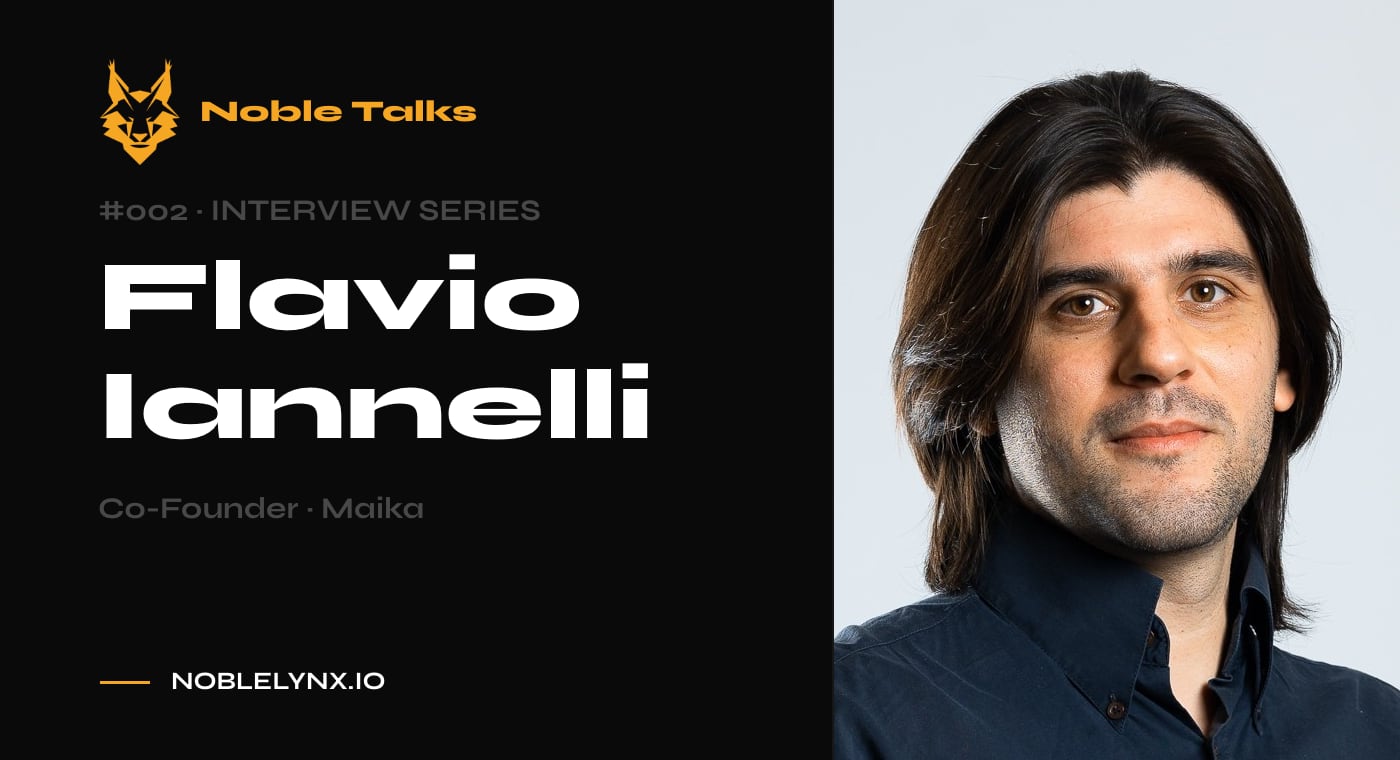
Noble Talks #002: Flavio Iannelli
1. Tell us about Maika. What’s the core research question you’re trying to answer, and what made you go after it?
MAIKA was born from a simple observation: music clearly affects people emotionally and physiologically, but the effect is deeply individual. The same track that helps one person focus or relax can have little effect, or even the opposite effect, on someone else.
The core research question behind MAIKA is whether we can model and understand the relationship between music, physiology, and emotional response in a measurable and personalized way. Instead of treating music for wellbeing as one-size-fits-all, we are exploring whether AI systems can learn how different people respond to different musical structures and adapt experiences accordingly.
We are a team of scientists, musicians, AI engineers and therapists all sharing the passion for music. My background is in theoretical physics and complexity science, so I naturally approached this as a complex systems problem. Human emotional response is noisy, dynamic, contextual, and highly personal. That makes it scientifically difficult, but also extremely interesting.
What pushed me to pursue it was the realization that music is one of the few technologies people already use voluntarily every day to regulate mood, focus, stress, and energy levels. We are not trying to replace human emotion with technology. We are trying to better understand the interaction between sound, physiology, and subjective experience, and build tools that support wellbeing in a more individualized way.
2. How do you translate something as subjective as emotional response into something a machine learning system can actually work with? Where does the science end and the engineering begin?
One of the biggest misconceptions in affective computing is the idea that emotions can be measured like fixed quantities. In reality, emotional states are probabilistic, contextual, and deeply personal.
Our approach is not to claim that a system can “know” exactly how someone feels. Instead, we look for measurable physiological patterns associated with changes in stress, arousal, relaxation, or focus, and combine those signals with behavioral and contextual information.
At a high level, we work with signals such as heart rate and derived biometric features that reflect autonomic nervous system activity. These are not direct measurements of emotion, but they provide meaningful information about physiological regulation and response.
The science provides the foundations: physiology, signal processing, psychology, neuroscience, and statistical modeling. Engineering begins when you try to build systems that operate in real-world conditions, with noisy sensors, imperfect data, different environments, and massive human variability.
3. What’s the hardest technical decision you’ve made building Maika? The tradeoff between research depth and shipping something people can actually use.
The hardest decision has probably been accepting that building a scientifically rigorous system and building a usable product operate on very different timescales.
As researchers or engineers, it is tempting to continue refining models, collecting more data, improving signal quality, or searching for better theoretical frameworks indefinitely. But real-world products require simplicity, robustness, and clear user value.
We had to consciously avoid building a “perfect research platform” that never reaches people. That meant prioritizing practical user experience, scalable infrastructure, and interpretable metrics, while still preserving scientific integrity.
In AI and wellbeing, there is also a strong temptation to overcomplicate systems with excessive sensing or highly invasive personalization. We chose to focus instead on lightweight, privacy-conscious approaches that can realistically scale and integrate into everyday life.
4. Where do most teams building at the intersection of AI and health or wellbeing get it wrong? A pattern you keep seeing.
A common pattern is treating human wellbeing as if it were a deterministic optimization problem.
People are not machines with a single correct emotional state. Human response changes across context, sleep, stress, personality, environment, culture, and even day-to-day fluctuations. Systems that ignore that complexity often overpromise and underdeliver.
Another issue is confusing correlation with understanding. Many systems detect patterns without deeply understanding causality or long-term effects. In wellbeing applications especially, humility matters.
I also think many teams underestimate trust. If a system interacts with something as intimate as emotion, attention, or stress, users need transparency about what is being measured, how personalization works, and where the boundaries of the technology are.
5. How do you think about risk when your system is directly influencing someone’s emotional state? Safety, ethics, unintended effects, where does your attention actually go?
We think about this constantly.
Music is powerful because it has already influenced human emotion for thousands of years. The responsibility comes from introducing AI systems into that loop. Our perspective is that these systems should support self-regulation and wellbeing, not manipulate behavior.
One important principle for us is avoiding exaggerated claims. We are very careful not to frame the technology as diagnosing mental health conditions or “controlling” emotions. Human emotional states are far too complex for simplistic narratives.
We also pay close attention to transparency, consent, privacy, and personalization boundaries. People should understand when physiological data is being used and why.
Another important area is unintended reinforcement. If AI systems only optimize for short-term engagement or stimulation, they can create unhealthy feedback loops. We are much more interested in long-term balance, sustainability, and healthy user relationships with technology.
6. What’s something that looked like a limitation, in the research, the data, the technology, that ended up shaping a better approach?
One major realization was that imperfect and noisy physiological data is not necessarily a weakness. In fact, designing around uncertainty forced us to build more adaptive and probabilistic systems.
Early on, it is tempting to think you need extremely controlled laboratory-quality measurements to build meaningful models. But if the goal is to create something usable in everyday life, you have to embrace variability instead of eliminating it completely.
That shifted our mindset significantly. Instead of searching for a single universal emotional model, we started thinking much more in terms of personalization, longitudinal adaptation, and relative change within individuals.
In many ways, the limitations pushed us toward a more realistic and human-centered approach.
7. What does responsible AI deployment mean when the output is something as intimate as music designed around your physiology?
For us, responsible deployment starts with respecting the fact that physiological data is deeply personal.
Users should have clarity about what data is collected, what is inferred, and how personalization operates. Privacy and transparency cannot be secondary considerations.
It also means recognizing the limits of the technology. AI systems can support experiences related to relaxation, focus, or wellbeing, but they should not pretend to replace clinicians, therapists, or human relationships.
Another important point is preserving agency. Personalized systems should help people better understand themselves and shape their own environments, not create dependency or passive consumption.
The long-term goal should be human empowerment, not behavioral control.
8. What are you paying attention to right now in affective computing or generative AI that most people aren’t?
One area I find especially interesting is the transition from static AI outputs toward adaptive and context-aware systems that evolve over time with the user.
A lot of generative AI today focuses on producing content that is impressive in the short term. I think the more important question is whether AI systems may eventually learn more meaningful long-term relationships.
I am also very interested in multimodal modeling, where physiological signals, behavioral context, audio features, and subjective feedback interact together instead of being treated independently.
More broadly, I think there is still a huge unexplored space between neuroscience, dynamical systems, music, and machine learning. Human emotional regulation is fundamentally temporal and adaptive, and I suspect future AI systems will move much closer to that perspective.
9. What would you tell yourself from two years ago about building a research-driven AI company?
I would probably say: focus earlier on clarity and simplicity.
Research naturally rewards complexity and exploration. Startups reward execution, prioritization, communication, and speed of learning. Balancing those two worlds is much harder than it looks.
I would also remind myself that uncertainty is part of the process. In research-driven companies, you often operate in spaces where there are no clear templates, no established metrics, and no guarantees that the assumptions will hold. That can feel uncomfortable, but it is also where genuinely novel ideas emerge.
Finally, I would say that building the right team and culture matters just as much as the technology itself. Especially in interdisciplinary fields, progress depends on people who can stay intellectually rigorous while remaining pragmatic enough to actually build.