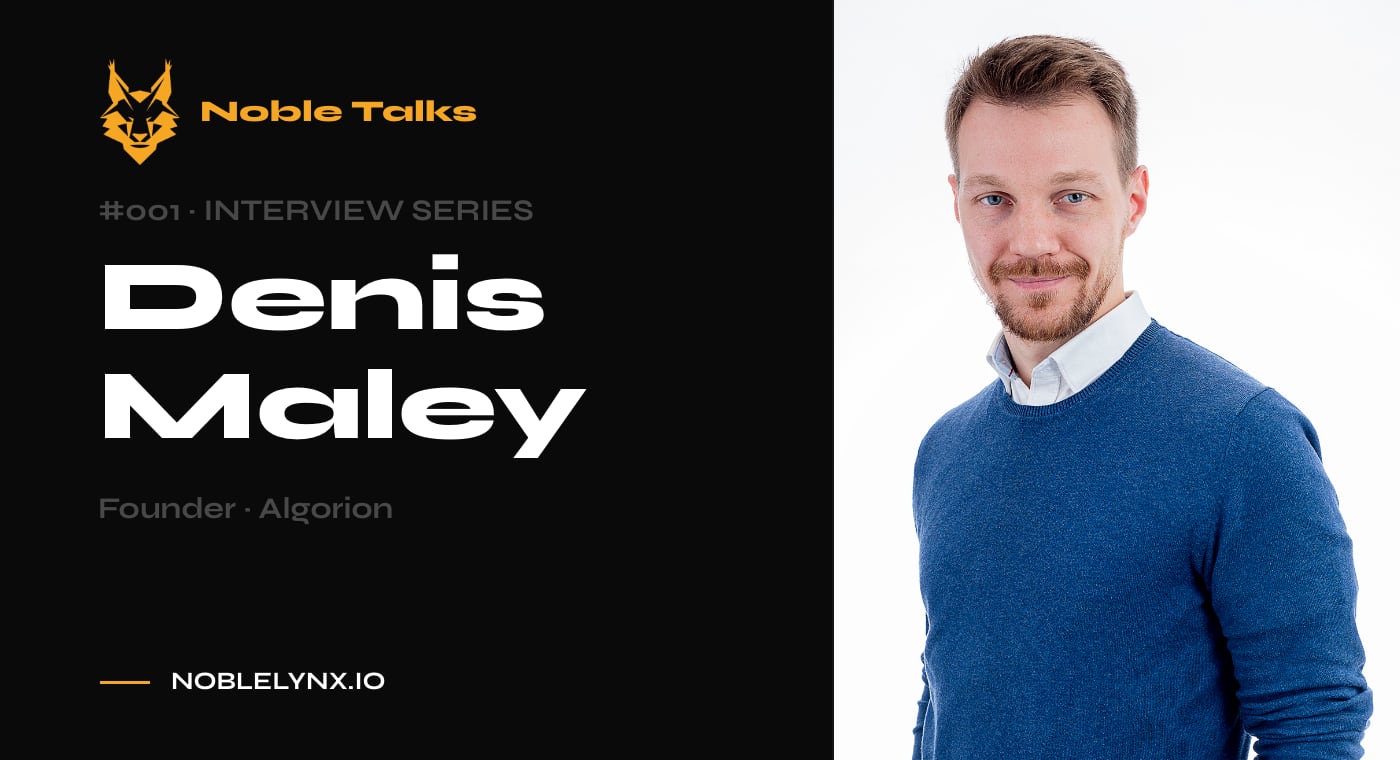
Noble Talks #001: Denis Maley
1. Tell us about what you’re building. What’s the core problem you’re solving, and what made you go after it?
I’m building Algorion Compass - an AI-powered investment analysis platform where multiple AI agents, each modeled after a legendary investor, work together to analyze stocks and support portfolio decisions.
The idea started with a simple question: what would Warren Buffett think about this stock? Or Michael Burry? Or Cathie Wood? Imagine having a board of the world’s most successful investors sitting around a table, each looking at the same company through their own lens - value, growth, contrarian, macro - and giving you their honest take. Dream team. That’s what Compass does.
I’m solving two sides of the same problem. For everyday investors, I want to help people invest with more confidence - not by telling them what to buy, but by giving them access to rigorous, multi-perspective analysis that used to be reserved for professionals. For those professionals, I want to eliminate the routine - the hours spent stitching together fundamentals, sentiment, technicals, and valuation models from scattered sources.
I went after this because I spent years building trading infrastructure and kept seeing the same gap: great execution systems, but the decision-support side was still either manual or based on technical analysis that doesn’t reflect the complete picture. I wanted to close that gap.
2. Where does AI actually live in your product or stack? Is it central to what you do, or more of an accelerant behind the scenes?
It’s a true 50/50 split between AI and data - both are core.
The data side handles everything deterministic: financial statements, price history, technical indicators, risk calculations, backtesting. That’s the foundation - without reliable, structured data, no amount of AI makes a difference.
The AI side is the reasoning layer. But this isn’t a chatbot or a prompt wrapper over an LLM. Each agent actually analyzes the data - reading financial statements, comparing metrics, evaluating trends - through the lens of a specific investment philosophy, built from the real footprint that investor left behind: their books, articles, interviews, shareholder letters, and public analysis. When the Warren Buffett agent evaluates a company, it’s applying the mental models Buffett has articulated over decades to real numbers. Same for Burry, Munger, Lynch, and the others.
The data tells you what’s happening. The agents tell you what different investment philosophies would make of it.
3. What’s the hardest technical decision you’ve made in the last 12 months? What were the tradeoffs, and would you make the same call today?
Designing the agent architecture - specifically, how agents reason individually and interact as a system.
The easy path would have been a single LLM call with a long prompt: “Analyze this stock as Buffett, Burry, and Wood.” That’s fast to build but shallow. You get a blended summary, not genuinely different perspectives. The harder path - which we took - was giving each agent its own reasoning pipeline. Each one receives the same data, applies its own framework independently, and produces a separate analysis. Then a Portfolio Manager agent synthesizes the results, weighing agreement, disagreement, and confidence levels.
The tradeoff is cost and complexity. More agents means more LLM calls, more orchestration logic, more failure modes. And you have to design the handoff between agents carefully - what information flows where, how conflicts are surfaced, how the final decision gets made without just averaging everything out.
Would I make the same call? Absolutely. The multi-agent approach is what makes Compass genuinely useful. A single-prompt system gives you one opinion dressed up in different voices. Separate agents give you actual tension between viewpoints — and that tension is where the insight lives.
4. Where do most teams get AI wrong? A pattern you keep seeing in how people build, ship, or think about it.
First, they skip evaluation. Teams ship AI features without a clear way to measure whether the output is actually good. In investment analysis, this is dangerous - a confident-sounding but wrong valuation is worse than no valuation at all. You need backtesting, you need benchmarks, you need to know when the system is wrong. Most teams don’t build that infrastructure because it’s not exciting. But it’s the difference between a toy and a tool.
Second, they treat AI as a shortcut instead of a new kind of architecture. Bolting an LLM onto an existing product and calling it “AI-powered” doesn’t change anything meaningful. The real work is rethinking your data flow, your feedback loops, and your failure modes. If the AI breaks, what happens? If it hallucinates, how do you catch it? If the underlying data is stale, does anyone notice? Teams that don’t ask those questions end up with impressive demos and unreliable products.
5. How do you think about risk when it comes to AI systems? Security, reliability, compliance, where does your attention actually go?
Reliability first. In investment systems, a wrong signal acted upon is a direct financial loss. So my priority is making sure the system fails gracefully - when an agent produces a low-confidence output, it says so rather than fabricating certainty.
Compass is deliberately designed as a decision-support tool, not an autonomous trader. The system does not execute trades. A human always sits between the analysis and the action. That’s not a limitation - it’s an architectural choice to manage risk. DYOR. Always.
Beyond that, I care about traceability. Every agent’s reasoning should be auditable - which data it used, which model produced the output, what the confidence level was. If you can’t trace the chain from data to recommendation, you can’t trust the system. And in finance, trust isn’t optional.
6. What’s something that looked like a problem but turned out to be an advantage? A constraint, a limitation, a setback that shaped how you build.
Not having Warren Buffett’s phone number. I’m serious. The whole idea behind Compass came from a limitation - you can’t call up legendary investors and ask what they think about your portfolio. But their thinking isn’t locked away. It’s scattered across decades of shareholder letters, interviews, books, and public analysis. The constraint was: how do you make that accessible without the person?
That limitation forced the entire product design. Instead of building another generic stock screener, we built a system that reconstructs investment philosophies from their public footprint. The constraint became the concept.
Same thing with being a bootstrapped, small team. We couldn’t build everything at once, which forced us to make the architecture modular from day one. Every agent is independent, every component is replaceable. If we’d had unlimited resources, we probably would have built a monolith and regretted it six months later.
7. What does responsible AI deployment mean to you in practice? Not the theory, what does it actually change in how you work?
Three things that actually change how I work.
First, be honest about what the system is. Compass is a research and analysis tool, not a trading system. It does not execute trades. That boundary exists because I’ve seen what happens when people over-trust AI outputs in financial contexts. Setting expectations clearly isn’t a disclaimer - it’s a design decision.
Second, make reasoning transparent. When an agent recommends something, you can see the data it used, the framework it applied, and the confidence level. No black boxes. If a user can’t understand why the system said what it said, the system failed.
Third, be honest about limitations. Financial data has licensing constraints, sentiment data can be manipulated, and LLMs can be wrong. Responsible deployment means surfacing uncertainty instead of hiding it.
8. What are you paying attention to right now that most people aren’t? A trend, a shift, a signal, something on your radar that isn’t loud yet.
AI agents that actually do the work, not just talk about it.
Most AI products in finance are still glorified chatbots - you ask a question, you get a summary. The shift I’m watching is toward agents that can pull real data, run analysis, and deliver a conclusion without a human doing the legwork in between. Not “here’s what I found on Google” but “I read the financials, ran the valuation, and here’s what three different investment frameworks say.”
We’re early, but the gap between what’s possible now and what most teams are actually shipping is enormous. That gap is the opportunity.
9. What would you tell yourself from two years ago? One thing about building with AI, leading a team through it, or just the work itself.
Build the evaluation framework before you build the product.
Two years ago, I would have spent weeks tuning prompts and experimenting with models before defining what “good” even looks like. Now I build the backtester and the benchmarks first. Once you know how to measure quality, everything else - model selection, prompt engineering, agent design - becomes an optimization problem instead of guesswork.
And one more thing: start shipping earlier than feels comfortable. The feedback you get from real users is worth more than another month of perfecting things in isolation.